
Using Home Equity to Buy an Investment Property: How Property Number Two Really Works
Suggested hero alt text: Home loan and property investment documents illustrating how home equity can be used toward a second property.
Owning a home does not automatically mean you can finance an investment property. But if your property has increased in value or your home loan balance has fallen, you may have built equity that can help fund the next purchase.
This is one of the most common pathways from homeowner to property investor — and one of the most misunderstood.
What Home Equity Actually Means
Home equity is the difference between your property’s current value and the debt secured against it. If your home is worth $900,000 and your home loan balance is $500,000, you have $400,000 of total equity.
But total equity is not the same as usable equity. A lender will determine how much of the property value it is prepared to lend against, taking into account loan-to-value ratio, borrower circumstances and its credit policy.
A Simple Usable Equity Example
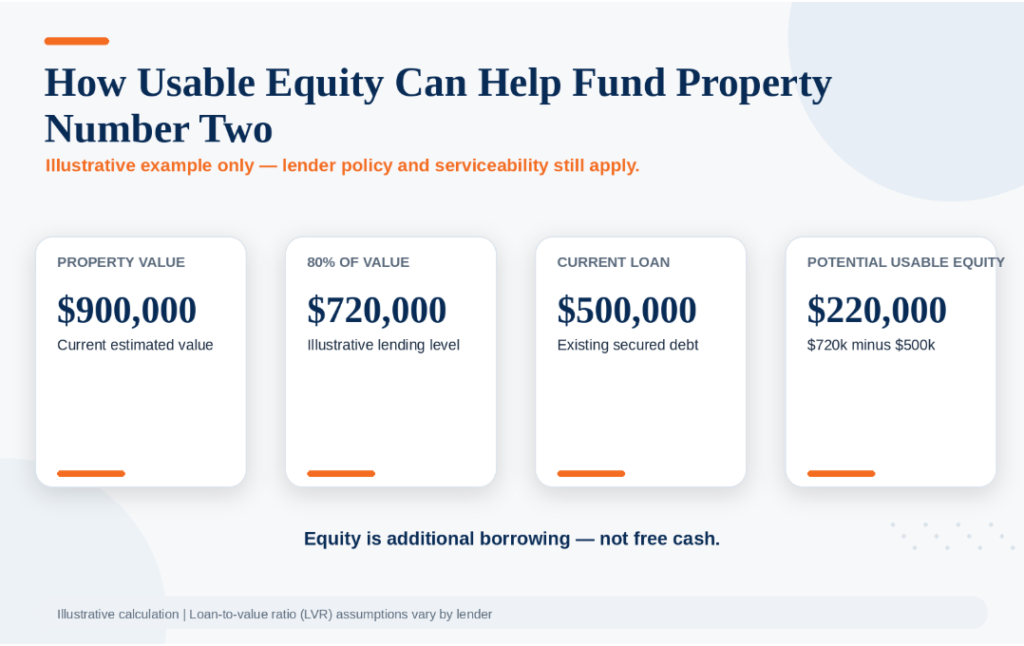
Assume, for illustration only, that a lender is comfortable with total lending up to 80% of a $900,000 property value.
- 80% of $900,000 = $720,000.
- Existing home loan = $500,000.
- Illustrative potential usable equity = $220,000.
This does not mean the bank will automatically advance $220,000. Valuation, serviceability, loan purpose and lender policy still apply.
Usable Equity Does Not Replace Borrowing Capacity
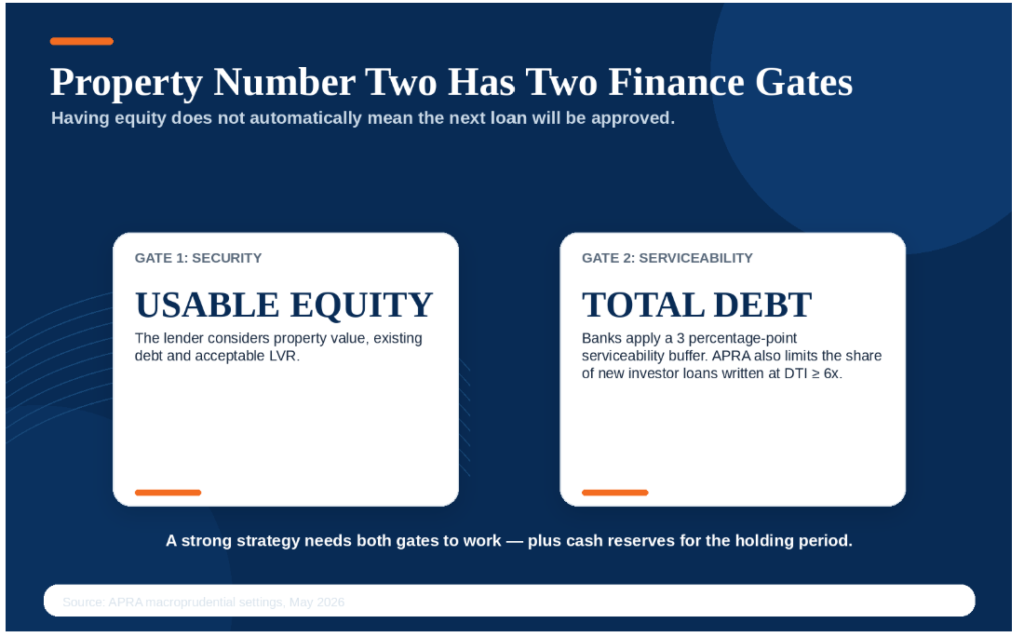
This is the most important part of the strategy. You can have substantial equity and still be unable to obtain the next loan.
Banks need to assess whether you can service all of the debt, not just whether there is enough property value to secure it.
APRA currently requires regulated banks to apply a 3 percentage-point serviceability buffer to new mortgage borrowers. APRA also limits each bank to writing up to 20% of new investor mortgage lending at a debt-to-income ratio of six times or more.
The DTI rule is not a blanket ban on borrowing above six times income. It is a limit on the share of new high-DTI lending each regulated bank can write.
Read APRA’s May 2026 macroprudential settings for the current framework.
How Equity Can Contribute to the Deposit and Purchase Costs
Subject to lender approval, released equity may contribute towards the investment-property deposit and potentially other eligible acquisition costs. The balance of the purchase is generally funded through a separate investment loan.
This can reduce the need to save a completely new cash deposit, but it also increases overall debt. Equity release is borrowing, not free money.
Why Loan Structure Matters When You Use Equity for an Investment Property
Where possible, investors often prefer to keep investment-purpose borrowing clearly separated from personal home-loan debt. Separate loan splits can make the purpose and management of each debt easier to track.
The tax treatment of interest depends on the use of borrowed funds and individual circumstances. A broker can help structure the lending; a qualified tax adviser should confirm deductibility and tax consequences.
The Hidden Question: What Happens After Property Number Two?
A good property-investment finance strategy should not stop at settlement. If property number two uses almost all available equity and pushes serviceability close to the limit, the purchase may succeed but property number three can become much harder.
That is why we think serious investors should plan in sequences, not isolated approvals.
Instead of asking only “How do I get this loan approved?”, ask “What does this loan do to the next decision?”
Our View at Extra Mile: Use Equity Deliberately, Not Simply Because It Is Available
Our view at Extra Mile is that equity is powerful because it can turn wealth already built in one property into purchasing capacity for another.
But the goal should not be to release the maximum amount a bank will allow. A stronger strategy considers usable equity, borrowing capacity, cash reserves, rental income, holding costs, rate risk and future purchases together.
What to Check Before Using Equity to Buy Property Number Two
- Current property valuation and existing loan balance.
- The lender’s acceptable LVR for your circumstances.
- Your total borrowing capacity after the equity release.
- Expected rental income and holding costs.
- Cash reserves remaining after settlement.
- Whether the loan splits clearly match the purpose of the borrowing.
- How the new debt affects your longer-term portfolio plan.
Thinking About Property Number Two?
Extra Mile can assess your current equity, borrowing capacity and possible loan structure before you start looking for the next property. Explore our property investor loan guidance or our renovation and equity options.