
Property Investment Finance in Australia: Will the Bank Fund Your Strategy?
Property investors often begin with the property: suburb, price, rental yield, development potential and expected capital growth. But there is another question that can completely change the strategy: will a lender actually finance it?
A property can look compelling on a spreadsheet and still be difficult to execute because the borrower, total debt, property security or lender policy does not work.
Australian Banks Finance Borrowers — Not Property Investment Spreadsheets
A property analysis and a credit assessment answer different questions. Your investment model asks whether the asset might produce an acceptable return. The lender needs to decide whether the debt can be repaid under its credit standards.
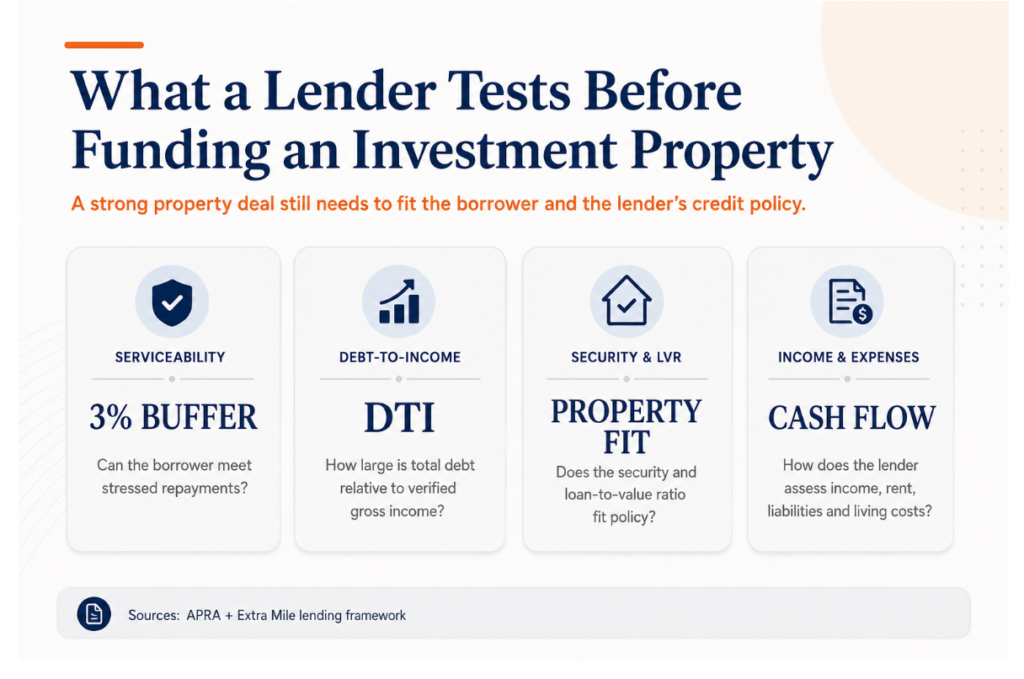
APRA — the Australian Prudential Regulation Authority — sets system-wide prudential guardrails for regulated banks. It currently requires a 3 percentage-point mortgage serviceability buffer for new borrowers.
You can read APRA’s current macroprudential settings directly.
Your Existing Debt Can Be More Important Than the Property’s Rental Yield
A new investment loan is assessed in the context of your broader position. Existing home loans, investment debt, personal loans, credit facilities, dependants, living expenses and verified income all influence the result.
That is why a property with attractive rent can still sit outside your borrowing capacity. The lender is assessing total household leverage and repayment capacity — not simply whether the rent covers the interest.
Debt-to-Income Limits Add Another Guardrail for Highly Leveraged Borrowers
Since 1 February 2026, APRA has limited each regulated bank to writing up to 20% of new investor mortgage lending at a debt-to-income ratio of six times or more. The same 20% limit applies separately to owner-occupier lending.
Importantly, this is not a rule saying nobody can borrow above six times income. It is a portfolio limit on how much high-DTI lending each bank can write.
Loan-to-Value Ratio and Property Security Still Matter
Even when serviceability works, the property itself must be acceptable security to the lender. Loan-to-value ratio (LVR), valuation, property type and location can influence the amount and structure of finance available.
This is particularly relevant for unusual properties, small apartments, specialist dwellings or development scenarios where lender appetite may vary.
Rental Income Helps, but Lenders Do Not All Assess It the Same Way
Lenders can differ in how they assess rental income, existing debts, variable income and expenses. That is one reason the same investor can receive materially different borrowing outcomes across different lenders.
A broker’s role is not only to compare interest rates. It is also to understand which credit policies fit the borrower and the property.
A High-Growth Property Strategy Still Needs to Survive the Holding Period
Some investors deliberately accept a lower rental yield because they expect stronger long-term capital growth. That can be a valid strategy — but the finance still has to survive the years before that growth is realised.
The investor needs enough capacity and liquidity to absorb interest, rates, insurance, management, maintenance, vacancy and unexpected costs.
If the strategy only works when interest rates fall, rent rises quickly and nothing goes wrong, the problem may not be the property. It may be the level of leverage.
Development and Renovation Strategies Add Timing Risk to the Finance
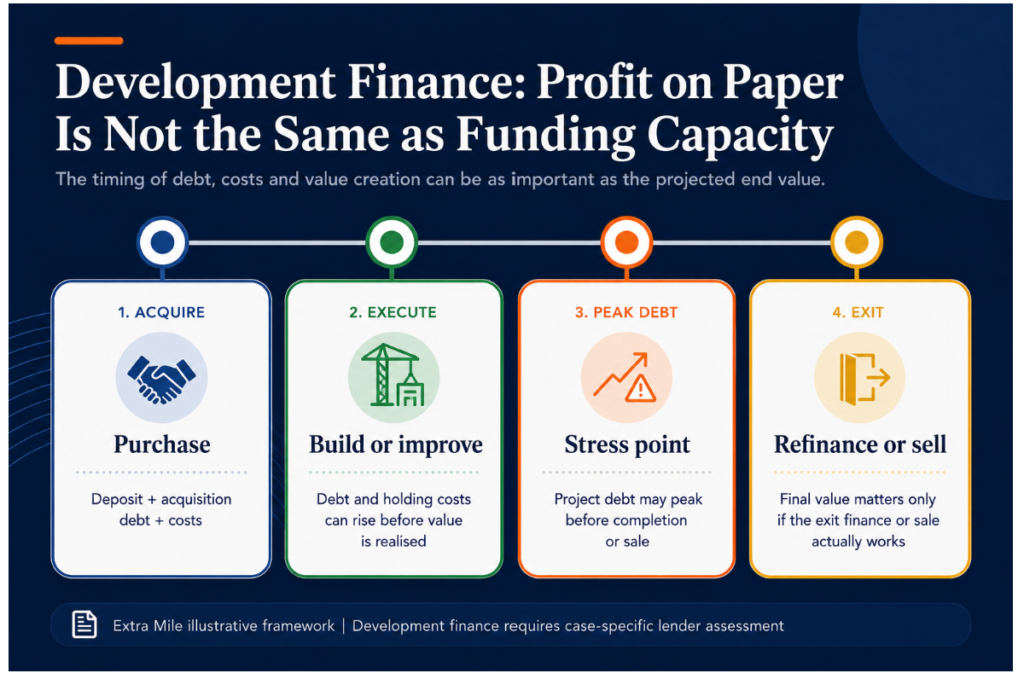
For subdivision, construction or major renovation, the projected end value can be misleading if it is viewed without the funding path.
Holding costs can accumulate before value is created. Debt may peak before completion. Construction costs can move. Timelines can stretch. And the eventual refinance depends on the completed valuation and the borrower still meeting lender policy at that point.
Why Finance Should Be Tested Before You Make the Property Offer
For serious investors, borrowing capacity should not be something discovered after the right property appears.
- Estimate realistic borrowing capacity and usable equity.
- Identify lender-policy constraints that may affect the property type or borrower profile.
- Model repayments and holding costs at current rates and under stress.
- Keep a liquidity buffer rather than using every available dollar at settlement.
- Consider how the new loan affects future acquisitions and refinancing.
Our View at Extra Mile: Property Analysis and Finance Analysis Need to Happen Together
Our view at Extra Mile is that the strongest investors combine two disciplines: property analysis and finance analysis.
A good property without workable finance is not an executable investment. And easy finance attached to a weak property is not a strategy either.
The aim is not simply to get the next loan approved. It is to build a lending structure that supports the investment thesis and preserves flexibility for what comes next.
Found an Investment Property or Development Opportunity?
Before committing, Extra Mile can help you understand whether the finance side of the strategy is likely to work and which lender options may fit. Explore our property investor lending approach.