
Negative Gearing Changes in Australia: What Property Investors Need to Know Before July 2027
Australia has now legislated one of the most important changes to residential property taxation in years. From 1 July 2027, negative gearing for residential property will generally be limited to new builds. Properties held before 7:30pm AEST on 12 May 2026 are grandfathered under the existing arrangements.
For property investors, this does not mean negative gearing disappears. It means the tax treatment of a future investment will depend much more heavily on when the property was acquired and whether it is new or established.
What Negative Gearing Means for Australian Property Investors
A residential investment is negatively geared when the deductible costs associated with the property exceed the income it generates. Under the existing system, eligible net rental losses can generally be used to reduce taxable income from other sources, such as salary or wages.
The Australian Taxation Office (ATO) provides the tax administration guidance, while the Australian Treasury sets out the legislated 2026–27 Budget reforms.
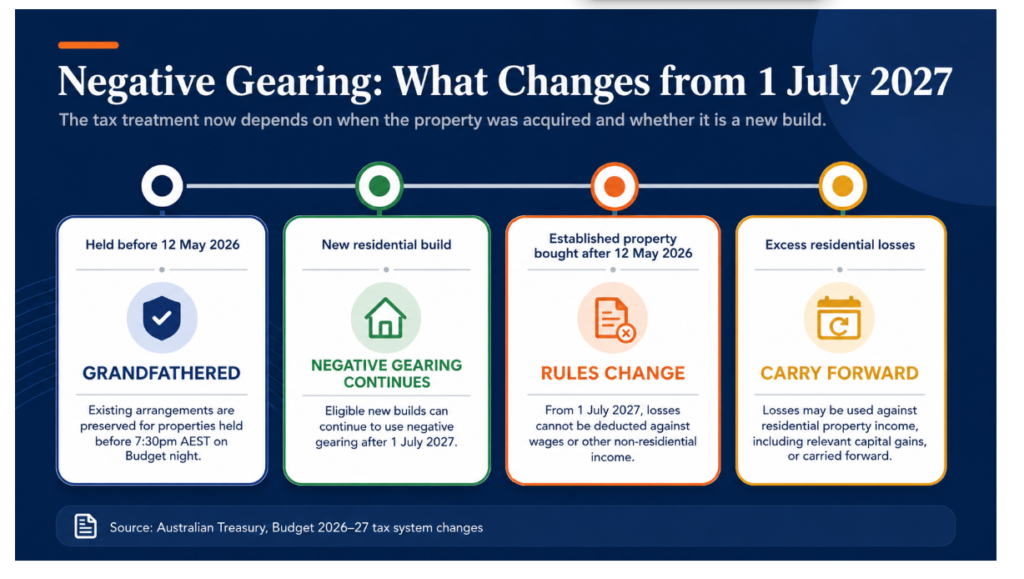
How the Negative Gearing Rules Change from 1 July 2027
The reform creates three broad categories that investors need to distinguish.
- Properties held before 7:30pm AEST on 12 May 2026: grandfathered and exempt from the new negative-gearing restriction.
- New residential builds: can continue to be negatively geared before and after 1 July 2027.
- Established residential property acquired after 12 May 2026: from 1 July 2027, residential losses cannot be deducted against non-residential income such as wages.
For established properties acquired after Budget night, Treasury says residential losses can still be deducted against other residential property income, including relevant capital gains, and excess losses can be carried forward to future years.
That distinction is important. The loss does not simply disappear, but the timing and value of the tax benefit can change materially.
Why New Builds Now Have a Clearer Tax Advantage for Investors
The Government’s stated objective is to direct tax support towards investment that adds to housing supply. New residential builds therefore retain access to negative gearing after July 2027.
That creates an obvious tax difference between a new investment property and an established one. But it does not mean every new apartment, townhouse or house-and-land package automatically becomes a better investment.
New property can carry its own risks: developer quality, construction delays, settlement valuations, concentrated future supply, strata costs and the possibility of paying a premium for a brand-new product. Established property can offer different strengths, such as known neighbourhood characteristics, established comparable sales, land content or opportunities to add value.
The Capital Gains Tax Rules Are Changing at the Same Time
The negative-gearing reform is only one part of the property-tax change. From 1 July 2027, the current flat 50% Capital Gains Tax discount for individuals, trusts and partnerships is being replaced by an inflation-based approach together with a 30% minimum tax rate on real capital gains accruing from that date.
Treasury says gains built up before 1 July 2027 retain the existing treatment. Investors in eligible new builds can choose between the existing 50% CGT discount and the new inflation-based arrangements.

Why Tax Benefits Should Not Rescue a Weak Property Investment
Our view at Extra Mile is that tax treatment should be one layer of the investment decision, not the investment strategy itself.
A property still needs to make sense when you look at the fundamentals: purchase price, rent, financing cost, vacancy, maintenance, expected holding period, cash reserves, property quality and exit options.
A tax deduction can reduce the after-tax cost of holding an investment. It cannot turn an overpriced property into a good purchase, and it cannot solve a loan structure that leaves the investor with no flexibility.
How the New Rules Interact with Property Investment Finance
- Is the property a new build or established dwelling for tax purposes?
- When was — or will — the property be acquired relative to 12 May 2026 and 1 July 2027?
- What is the property’s cash flow before tax?
- How much debt and usable equity does the strategy require?
- What happens if interest rates stay high or rent grows more slowly than expected?
- How does the loan affect future borrowing capacity?
- What is the likely CGT treatment if the property is held beyond July 2027?
Our View at Extra Mile: Rebuild the Investment Calculation, Don’t Chase the Tax Rule
We would not respond to these reforms by automatically moving every investor from established property to new builds. The better response is to rebuild the investment calculation from the ground up.
Start with the property, cash flow, debt and risk. Then layer the tax treatment over the top. That produces a much clearer picture of whether the investment still works under the new rules.
Thinking About Your Next Investment Property?
Extra Mile can help you understand the finance side of the strategy — including borrowing capacity, usable equity, lender options and loan structure. You can also explore our property investor loan guidance.
Important: Extra Mile provides mortgage and finance guidance, not personal tax advice. Property investors should confirm the tax implications of the reforms with a qualified accountant or registered tax adviser before making investment decisions.