
Adelaide vs Sydney Property Market 2026: What the Latest Data Says for Buyers and Investors
For much of the recent property cycle, Adelaide and Sydney looked like two very different markets. Sydney began weakening first, while Adelaide remained remarkably resilient. That gap is now narrowing — but the two cities are still not moving in the same way.
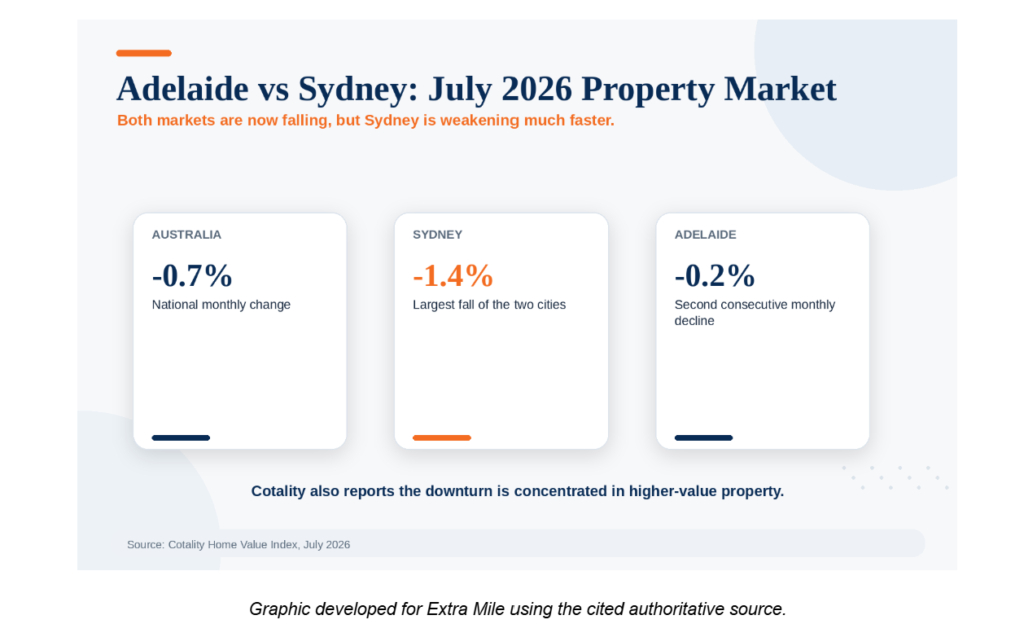
Cotality’s July 2026 Home Value Index shows Sydney dwelling values fell 1.4% in the month, while Adelaide fell 0.2%. Historical revisions indicate both cities have now recorded two consecutive monthly declines.
Sydney Is Leading the Australian Property Market Downturn
Sydney reached its recent peak in January 2026. Since then, affordability pressure, higher mortgage rates and weaker demand have pushed values lower. July’s 1.4% decline was one of the sharpest among the capital cities.
You can follow the latest data directly through Cotality’s Home Value Index analysis.
For Sydney buyers, falling values can improve negotiating conditions, but the finance challenge remains significant: larger loan sizes and higher interest rates can still restrict borrowing capacity.
Adelaide Has Turned Negative — But the Adjustment Is Much Smaller
Adelaide’s 0.2% July decline is modest compared with Sydney, but it matters because it confirms a market that had been unusually resilient is now responding to the same national headwinds.
The shift may reduce some of the urgency that characterised Adelaide during its stronger growth phase. It does not mean every suburb or price segment is falling at the same rate.
The Higher End of the Australian Property Market Is Weakening Fastest
One of the most important details in the current downturn is where the weakness is concentrated. Cotality reports that upper-quartile home values fell 3.2% nationally over the three months to July, while the lower quartile still recorded a 0.3% gain.
That matters because a city-wide figure can hide very different conditions by suburb, property type and price point. A buyer looking at a high-end Sydney house is not necessarily experiencing the same market as someone competing for a lower-priced unit or an affordable Adelaide suburb.
More Property Listings Are Changing the Negotiating Environment
Across the combined capital cities, advertised property supply is now 5.7% above the five-year average. Cotality also reports capital-city auction clearance rates have remained below 50% since late May.
For buyers, this can mean more choice, more time for due diligence and less pressure to make an emotional offer. For vendors, it can mean a larger gap between asking prices and what buyers are prepared to finance.
Adelaide and Sydney Rental Markets Remain Tight Despite Falling Values
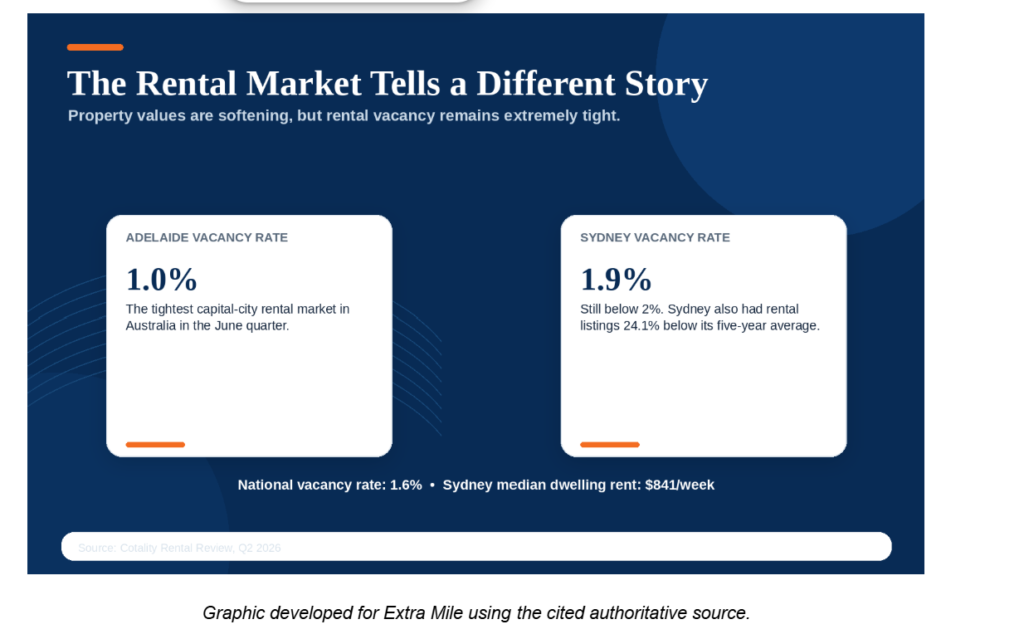
The rental market is telling a different story from property values. Cotality’s Q2 2026 Rental Review recorded a national vacancy rate of 1.6%. Sydney was at 1.9%, while Adelaide remained the tightest capital-city rental market at just 1.0%.
Sydney’s median dwelling rent reached $841 per week in June, and its gross rental yield rose to 3.3% as home values weakened. Cotality notes that gross yields remain below the cost of capital in many locations, which is an important reminder that strong rental demand does not automatically mean positive cash flow.
What the Adelaide vs Sydney Market Means for Home Buyers
For home buyers, the most useful change may be time. In a fast-rising market, buyers often feel they must compromise quickly. In a softer market, there may be more opportunity to compare properties, negotiate and complete proper due diligence.
The trade-off is that finance remains restrictive. The RBA cash rate is 4.35%, and APRA’s 3 percentage-point serviceability buffer continues to affect borrowing capacity.
What the Adelaide vs Sydney Market Means for Property Investors
For investors, price weakness and rental tightness can coexist. That creates opportunities, but also makes the financing calculation more important.
An investor comparing Adelaide and Sydney should consider purchase price, rent, gross yield, vacancy, leverage, holding costs, tax treatment and the effect of the new loan on future borrowing capacity. City-wide growth rankings alone are not enough.
Our View at Extra Mile: Stop Asking Which City Is “Better”
Our view at Extra Mile is that “Adelaide or Sydney?” is the wrong question unless the investor first defines the objective.
Sydney offers scale, economic depth and a much larger property market, but entry costs are high and the current downturn is deeper. Adelaide is more affordable and has exceptionally tight rental conditions, but it has also already experienced a long period of strong growth and is now losing momentum.
The more useful question is: what type of property, debt level and holding strategy fits your financial position?
What to Watch Next in the Adelaide and Sydney Property Markets
- Property listings: does advertised supply stay above normal levels or begin to tighten again?
- Price segments: does weakness remain concentrated in the upper quartile or spread further into affordable housing?
- Rental vacancy: Adelaide’s 1.0% vacancy rate and Sydney’s 1.9% rate are both extremely tight by historical standards.
- Home loan conditions: changes in mortgage rates and borrowing capacity can alter demand even without a major change in property prices.
- Tax policy: the negative-gearing and CGT reforms beginning in July 2027 may affect investor demand differently across new and established housing.
Thinking About Buying in Adelaide or Sydney?
Extra Mile can help you understand your borrowing position and loan structure before you start making serious offers. If you are investing, you can also explore our property investor loan guidance.