
RBA Holds Cash Rate at 4.35%: What It Means for Australian Home Buyers in 2026
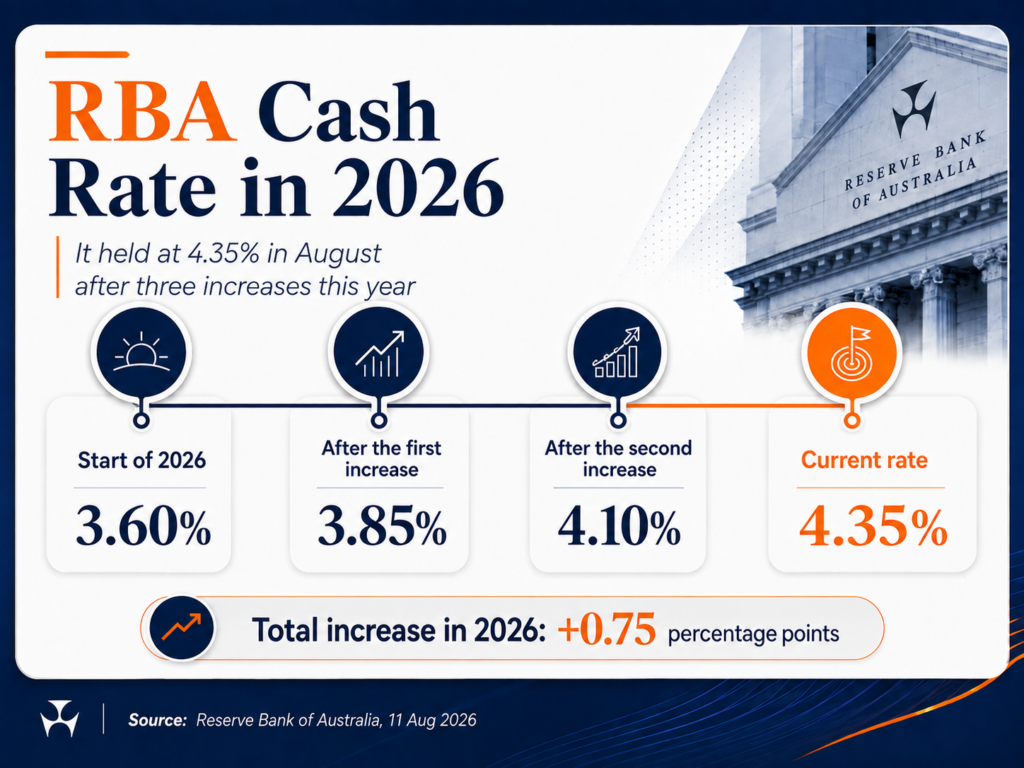
On 11 August 2026, the Reserve Bank of Australia left the official cash rate unchanged at 4.35%.
The decision follows three interest-rate increases earlier this year — a total rise of 0.75 percentage points — as the RBA continues to deal with inflation that remains above where it wants it to be. The Bank now describes monetary policy as “somewhat restrictive”, meaning interest rates are high enough to deliberately slow demand in the economy.
For Australians thinking about buying a home, however, the most useful question is not: Will the RBA raise or cut rates next?
It is: What do today’s interest rates actually mean for my home loan, my borrowing capacity and the property I can realistically afford?
Those are related questions, but they are not the same thing.
How the RBA Cash Rate Affects Australian Home Loan Interest Rates
The cash rate is the interest rate targeted by the Reserve Bank of Australia for overnight lending between banks. It sits at the centre of Australian monetary policy and influences other interest rates across the economy, including home loan and deposit rates.
Technically, the RBA does not set your mortgage interest rate.
Banks still price home loans according to funding costs, competition, risk, loan type and individual borrower circumstances.
In practice, however, the connection between RBA decisions and Australian variable home loan rates has recently been very direct. The RBA says banks have passed on the three 2026 cash-rate increases to mortgage and business lending rates, with variable mortgage rates increasing by nearly 75 basis points between January and June. Read the RBA’s August 2026 financial conditions analysis
So while the cash rate and your home loan rate are not technically the same thing, for Australian borrowers with variable home loans, recent RBA moves have flowed through very closely.
That is why RBA announcements matter so much to homeowners and buyers.
How APRA’s Mortgage Serviceability Buffer Affects How Much You Can Borrow
There is another institution home buyers should understand alongside the RBA: APRA. The Australian Prudential Regulation Authority supervises Australian banks and other authorised deposit-taking institutions and sets prudential rules designed to keep the financial system stable.
One of those rules directly affects how lenders calculate your borrowing capacity.
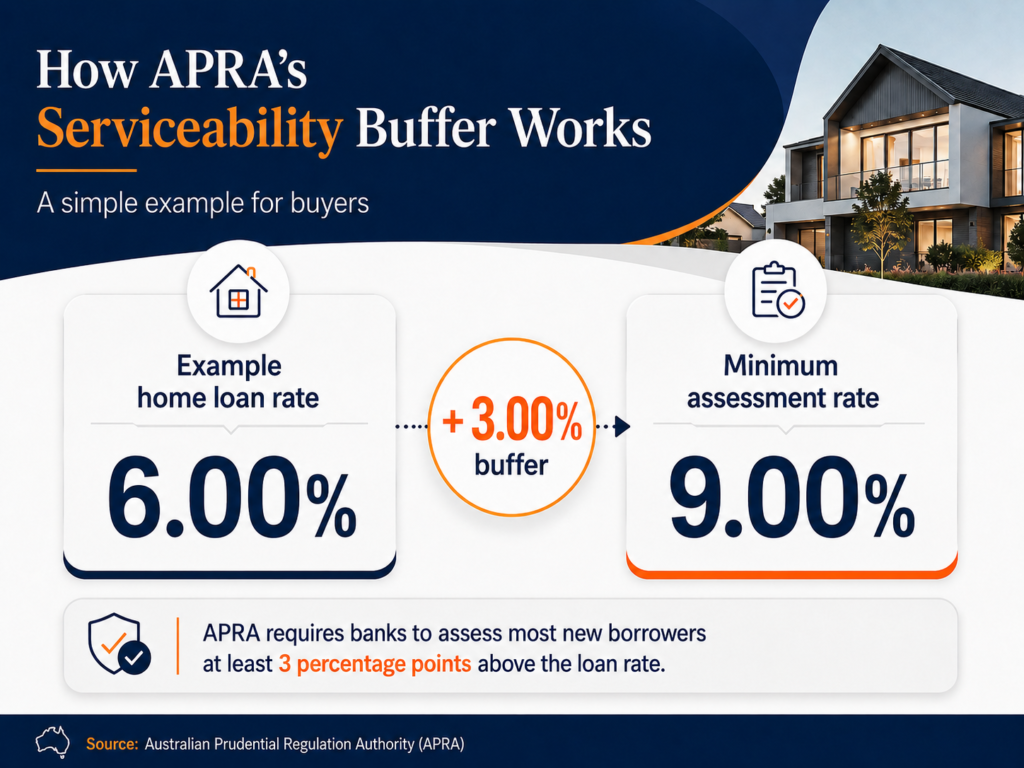
APRA currently requires banks to apply a minimum mortgage serviceability buffer of 3 percentage points above the home loan interest rate when assessing a new borrower’s ability to repay a mortgage.
What does this mean in practice?
If the home loan you are considering has an interest rate of 6%, the bank does not simply ask whether your income and expenses could support repayments at 6%.
For its serviceability assessment, it generally needs to test your capacity at a rate of at least 9%.
That does not mean you will pay 9%. It means the bank wants to see whether your household finances could withstand a significantly higher repayment before approving the loan.
This is one of the reasons rising home loan interest rates can reduce borrowing capacity quite quickly. If the actual mortgage rate rises, the assessment rate normally rises with it. And that can change the maximum amount a lender is prepared to offer you even if your income has not changed.
If you want to understand the broader factors lenders consider, our guide to how much you can borrow for a home loan explains borrowing capacity in more detail.
Higher Interest Rates Affect More Than Your Home Loan Repayments
Most discussion about interest rates focuses on one thing: monthly mortgage repayments.
That matters, of course. But higher home loan interest rates can influence several parts of a property purchase at the same time.
- Increase the repayment on the home loan you eventually take out.
- Reduce your borrowing capacity.
- Increase the serviceability assessment rate used by lenders.
- Make existing personal loans, car finance and credit commitments more significant.
- Increase holding costs for property investors.
- Change how comfortable it feels to borrow close to your maximum limit.
At the same time, higher interest rates can also reduce competition in the property market. That second effect is becoming increasingly visible in 2026.
Australian Property Prices Are Softening — and Buyers Have More Choice
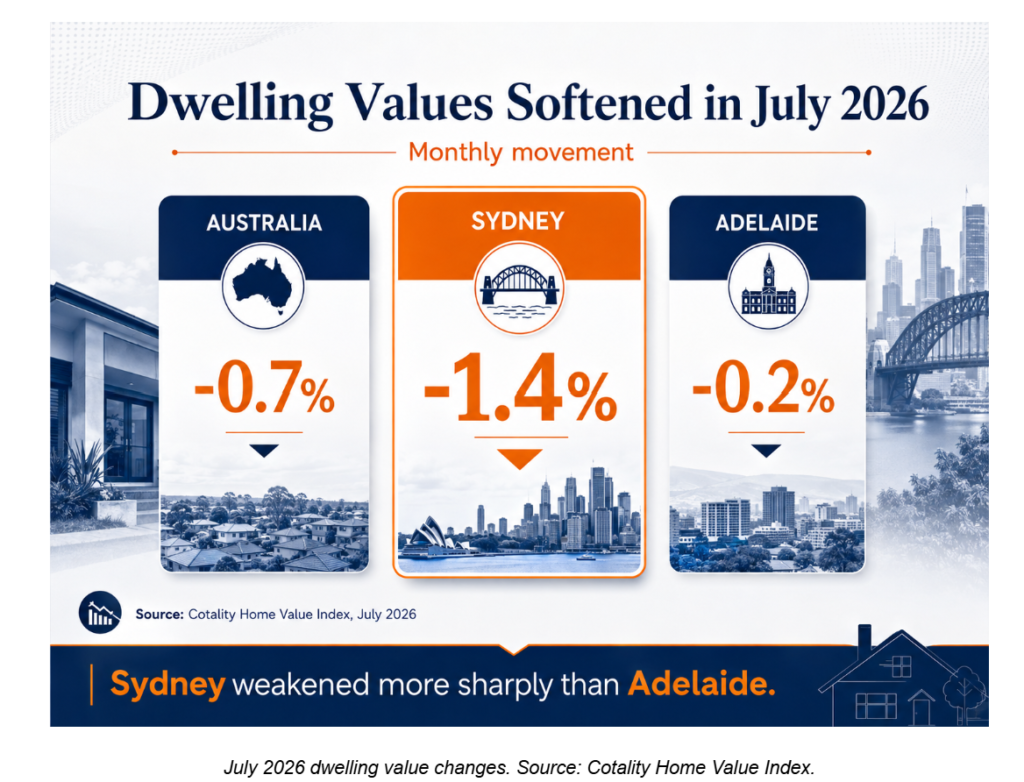
Cotality’s latest Home Value Index shows that Australian dwelling values fell 0.7% in July 2026, the largest monthly decline since December 2022. Sydney recorded a 1.4% monthly fall. Adelaide, which had remained far more resilient, declined 0.2%.
Importantly, the change is not just appearing in property prices. Across the combined capital cities, advertised property supply is now 5.7% above the five-year average, while capital-city auction clearance rates have remained below 50% since late May.
You can read Cotality’s full analysis of the Australian housing market downturn for the underlying market commentary and data.
For potential buyers, this matters. During a rapidly rising property market, buyers can feel pressure to act immediately because there may be several competing offers and another suitable property may not appear for weeks.
A softer Australian property market can change that dynamic.
- More properties to compare.
- More time to complete due diligence.
- Less pressure to make an emotional offer.
- Potentially more scope to negotiate with a vendor.
So higher interest rates create an unusual trade-off: finance has become more expensive, but buying conditions in parts of the property market are becoming more favourable.
Falling Property Prices Do Not Automatically Make Australian Homes More Affordable
This is where property prices and home loan finance need to be considered together.
Imagine you are considering a property priced at $750,000.
If that property falls 5% in value, the price drops by $37,500. Clearly, that matters. But it does not automatically mean the property has become $37,500 “more affordable” to you.
While you wait, several other variables can change:
- Your home loan interest rate.
- Your borrowing capacity.
- Your income.
- Your expenses.
- Your deposit.
- The rent you continue paying.
- The supply of the particular type of property or suburb you want.
You can also experience a situation where the property price falls but your borrowing capacity falls at the same time.
That is why we think buyers need to look at property affordability as a combination of purchase price and finance, rather than treating the property price as the only number that matters.
Should You Buy a Home Now or Wait for the Next RBA Interest Rate Move?
An RBA cash-rate decision should not be treated as a green or red light for buying property.
There is no single interest-rate level at which everyone should buy, just as there is no single property-market decline that makes waiting the correct decision.
A household with stable employment, a strong deposit, comfortable repayments, emergency savings and plans to remain in the property for many years is in a very different position from a household that needs to borrow at the absolute edge of its borrowing capacity.
Instead of trying to predict the next RBA meeting, it can be more useful to stress-test your own position.
- Would the home loan repayments still feel comfortable if interest rates rose further?
- Would I still be happy owning this home if its market value fell temporarily after I bought it?
- Would this purchase still work if Australian property prices remained relatively flat for several years?
- Am I buying because the property suits my financial and personal goals, or because I am afraid of missing out?
These questions cannot tell you where the market will be next year. But they can tell you far more about whether you are ready to buy.
Our View at Extra Mile: A Softer Property Market Can Create Better Buying Conditions
Our view at Extra Mile is that the current environment should not simply be described as “bad for buyers” because interest rates are high.
There are two things happening at the same time.
On one side, higher home loan interest rates have reduced borrowing capacity and made repayments more expensive.
On the other, weaker buyer demand and increasing property listings are starting to create conditions that may give well-prepared buyers more choice, more time and greater negotiating power.
That combination can create opportunities. But it does not mean every falling property is a good buy. Nor does it mean buyers should try to predict the exact bottom of the Australian property market.
We think a better position is to know what you can comfortably borrow, what you are willing to repay and what type of property genuinely fits your objectives.
Then, if the right property appears, you can assess it on its merits rather than making the decision based on the latest interest-rate headline.
What Australian Home Buyers Should Watch Next in Interest Rates and the Property Market
If you are considering buying a home over the coming months, there are three areas we think are particularly worth following.
- Australian inflation and the next RBA interest-rate decisions
The RBA has made clear that inflation remains its central concern. In its 11 August decision, the Board said inflation was still too high and that it would be prepared to increase the cash rate further if upside risks materialised. Read the RBA’s 11 August 2026 monetary policy decision
That means buyers should not build a property strategy around the assumption that significantly lower home loan rates are just around the corner.
- Home loan rates and lender borrowing-capacity policies
The RBA cash rate receives most of the attention, but the home loan rate you are actually offered and the lending policy applied to your circumstances are what determine your real borrowing position.
Different lenders can assess income, expenses, employment types and existing commitments differently. That is why knowing your borrowing capacity before seriously searching for property can be more useful than relying on a generic online home loan calculator.
- Property listings, selling times and negotiating conditions
A softer property market becomes particularly interesting when buyers have more properties to choose from and vendors have fewer competing offers.
If advertised supply remains elevated and buyer demand remains subdued, the negotiating environment may continue to shift.
That does not necessarily tell us where property prices will go. But it does tell us something important about who has more leverage in an individual transaction.
Thinking About Buying a Home in Australia?
Before deciding how much to offer on a property, it helps to know what lenders are likely to offer you — and what the repayments would mean for your household under different interest-rate scenarios.
At Extra Mile Financial Services, we can help you understand your borrowing capacity, home loan options and loan structure before you start making serious offers.
Talk to Extra Mile about your home loan options.