
Buying your first home with a 5% deposit in Adelaide
Final bilingual article explaining the Australian Government 5% Deposit Scheme, lender approval and the real cash/repayment picture.
The Australian Government 5% Deposit Scheme can allow an eligible first-home buyer to purchase with a minimum 5% deposit and without paying Lenders Mortgage Insurance. Since 1 October 2025, the Scheme has no income caps, no waiting list and unlimited places.
For Adelaide, the current South Australian capital-city property price cap is AUD 900,000. That has made the Scheme relevant to a much wider range of buyers. But a 5% deposit does not mean “5% is all you need”, and Scheme eligibility does not mean a lender must approve the loan.

Who can use the 5% Deposit Scheme?
For the first-home-buyer stream, the Australian Government says applicants need to meet criteria including:
- Be an Australian citizen or permanent resident and at least 18 years old.
- Have saved a minimum deposit of 5% of the lender-assessed property value.
- Be a first-home buyer or not have owned property or land in Australia in the previous 10 years.
- Buy an eligible home in Australia at or below the relevant price cap.
- Live in the property as an owner-occupier. Investment properties are not eligible.
- Use an eligible principal-and-interest owner-occupier loan from a participating lender, generally up to 30 years, with additional time allowed for some builds.
- Apply alone or jointly with one other eligible person.
You must also satisfy the participating lender’s normal credit policy and loan approval requirements. The Government guarantee supports the lender; it does not replace the lender’s assessment.
The Adelaide price cap is AUD 900,000 — but check both price and valuation
For South Australia, the Scheme currently sets the cap at AUD 900,000 for Adelaide and AUD 500,000 for other areas. Both the purchase price and the value assessed by the participating lender must be at or below the relevant cap.
That second point matters. A deposit under the Scheme is based on the lender-assessed value. If the lender’s valuation differs from the contract price, the amount of cash you need can change. Confirm the cap and valuation position before assuming a contract fits the Scheme.
What does 5% change in the numbers?
Consider a AUD 700,000 home. A 5% deposit is AUD 35,000. A 20% deposit is AUD 140,000 — a difference of AUD 105,000 in deposit savings.
But the smaller deposit also means a larger loan. Ignoring other costs, a 5% deposit leaves an indicative loan of AUD 665,000, compared with AUD 560,000 after a 20% deposit.
At an illustrative rate of 6.5% over 30 years, principal-and-interest repayments would be about AUD 4,203 per month on AUD 665,000 versus about AUD 3,540 per month on AUD 560,000. The rate is an example only, not a current offer or recommendation.
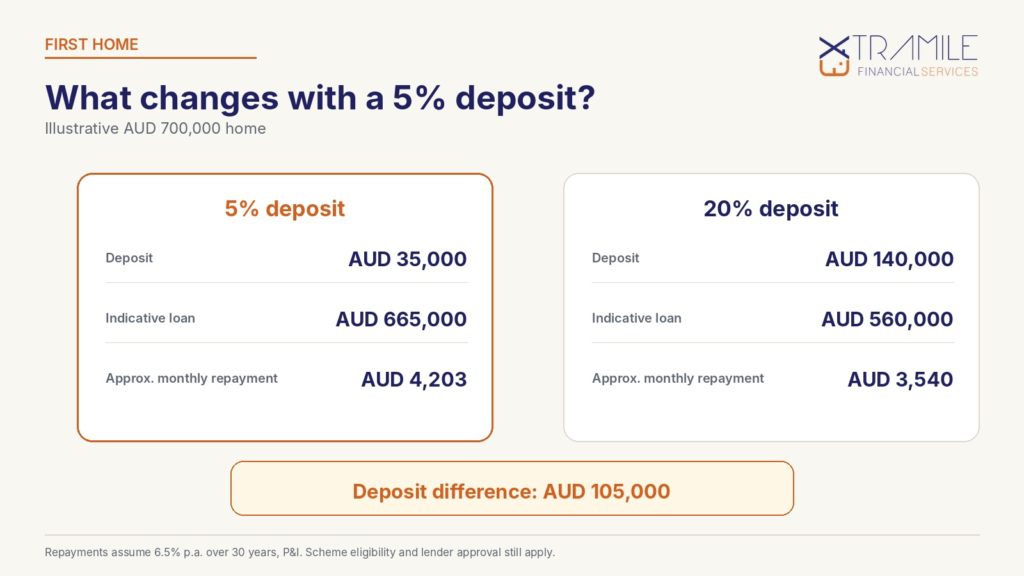
The Scheme can therefore solve one problem — the time required to accumulate a large deposit — while creating a different financial profile: a bigger loan balance and higher repayments.
5% is the deposit, not the entire buying budget
The Scheme’s own FAQs make this clear: buyers remain responsible for home-loan costs and other purchase expenses. Depending on the transaction, those can include conveyancing, building and pest inspections, transfer or registration fees, lender costs, insurance, moving expenses and any stamp duty that applies.
South Australian first-home-buyer grants and stamp duty relief can also change the upfront budget, particularly when comparing new and established homes. We deal with that separately in our guide to the upfront cost of a new versus established home, because it is a different decision from the federal 5% Deposit Scheme.

Deposit savings are only one part of the upfront home-buying budget.
A lower deposit should not become a higher purchase target by default
Access to a 5% deposit does not mean you should automatically buy at the maximum price allowed by the Scheme or at the maximum amount a lender will approve.
A useful pre-purchase review looks at the repayment you can manage, expected rates and buffers, current debts, household expenses, future plans and how much cash will remain after settlement. That matters especially when the deposit is small, because there is less equity cushioning the purchase at the beginning.
How we look at it at Extra Mile
The Scheme is valuable when the main barrier is accumulating a larger deposit and the ongoing loan still works comfortably. The question we would rather answer before you start making offers is not simply “Am I eligible for 5%?” but “If I use it, what does the whole purchase look like for me?”
That means checking eligibility, lender policy, the property cap, valuation, other buying costs and the repayment together.
What to have ready for an initial review
- Your current deposit and where those savings came from.
- Income and employment information for each applicant.
- Existing loans, credit cards and other commitments.
- The suburbs and price range you are considering.
- Whether you are looking at a new or established home.
- A comfortable monthly repayment range, not only the maximum possible borrowing amount.
A pre-approval or early lending review can help turn those numbers into a realistic property search before you sign a contract.
Check your first-home budget with Extra Mile
Extra Mile can help you review Scheme eligibility, lender requirements, the property price cap and the repayments together before you start making offers. Talk to Juan in English or Spanish.
General information only. This article does not take account of your individual circumstances and is not personal financial, investment or tax advice. Lending is subject to lender assessment and approval. Figures are illustrative and exclude fees unless stated.