
New to Australia? How Residency Status Affects Buying Property and Getting a Home Loan in 2026
Buying a home in Australia can be confusing for anyone. If you are new to the country, there is another layer: your visa or residency status can affect the property you are allowed to buy, government support and the lenders available to you.
These are related questions, but they are not the same. Being legally allowed to buy a property does not automatically mean a lender will finance it — and being eligible for a home loan does not remove foreign-investment rules.
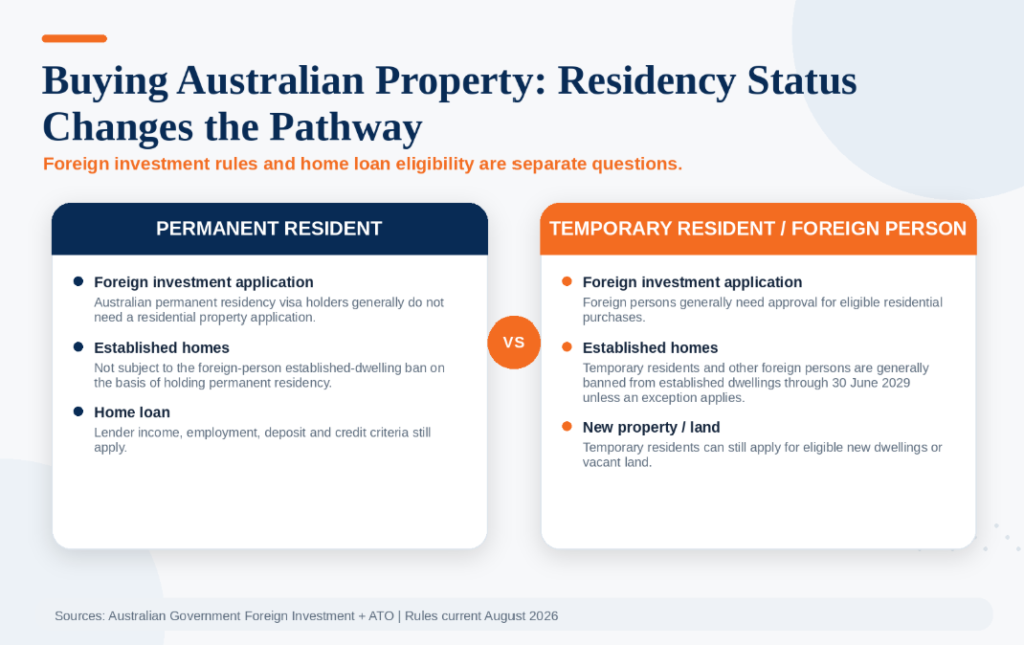
Australian Permanent Residents Generally Do Not Need Foreign Investment Approval for Residential Property
The Australian Government’s foreign-investment guidance states that holders of Australian permanent residency visas generally do not need to lodge a residential real estate application.
Australian citizens living overseas and eligible New Zealand citizens are also exempt in specified circumstances. You can check the current exemptions directly on the Australian Government Foreign Investment residential real estate page.
Temporary Residents and Other Foreign Persons Face Much Tighter Rules on Established Homes
Foreign persons — including temporary residents — are generally banned from purchasing established residential dwellings in Australia unless a limited exception applies.
The ban began on 1 April 2025 and the Government announced in May 2026 that it would be extended. Current ATO guidance states the ban runs through 30 June 2029.
Temporary residents can still apply for approval to purchase eligible new dwellings or vacant land, subject to the foreign-investment framework and application requirements.
Because these rules can carry significant consequences, anyone who may be a foreign person should confirm their status and approval requirements before signing an unconditional property contract.
Foreign Investment Approval and Home Loan Approval Are Separate Tests
Even if you are legally permitted to buy the property, lenders still apply their own credit rules.
Depending on the lender and your circumstances, they may consider residency or visa type, Australian or overseas income, employment history, deposit, existing debts and credit history.
This is one reason comparing lender policy matters for people new to Australia. A borrower outside one lender’s policy may fit another lender more comfortably.
South Australian First Home Buyer Support Also Has Residency Rules
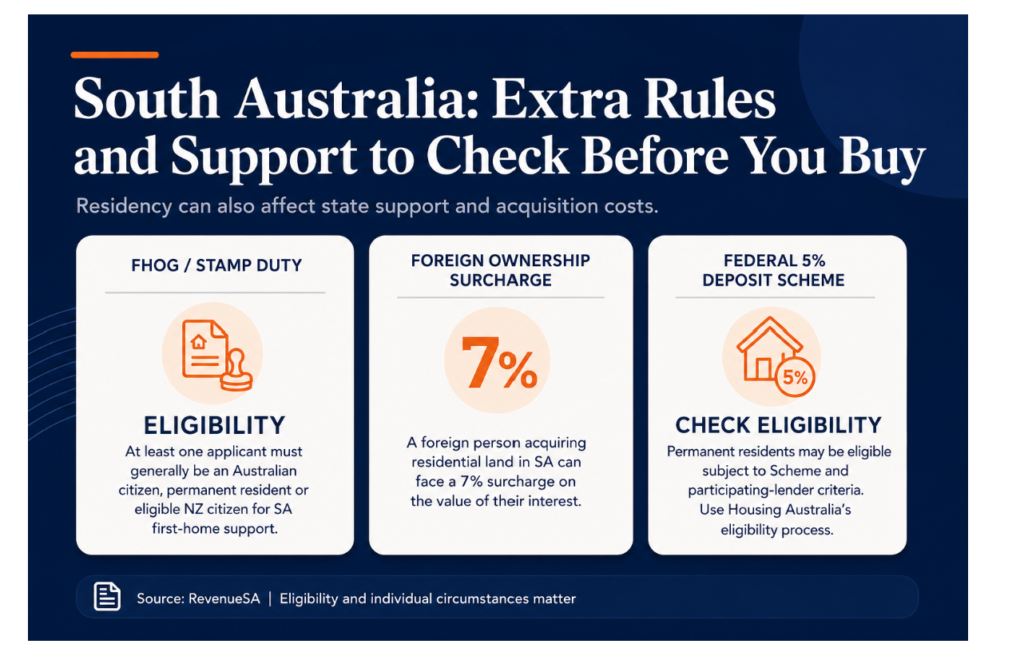
In South Australia, at least one applicant for the First Home Owner Grant or first-home stamp duty relief must generally be an Australian citizen, Australian permanent resident or eligible New Zealand citizen.
RevenueSA also applies a 7% foreign ownership surcharge to the value of the interest acquired by a foreign person in residential land. In a joint purchase, the surcharge can therefore apply only to the foreign purchaser’s interest, depending on the ownership structure and circumstances.
Check the official criteria through RevenueSA’s First Home Buyer guidance and Foreign Ownership Surcharge page.
Permanent Residents May Also Have Access to the Australian Government 5% Deposit Scheme
The Australian Government 5% Deposit Scheme can allow eligible first home buyers to purchase with a minimum 5% deposit and no Lenders Mortgage Insurance. Housing Australia has supported permanent-resident households through the Scheme, but current eligibility and participating-lender criteria should always be checked before relying on it.
The Scheme can support eligible existing or new homes within the relevant property price cap. For the South Australian capital-city area, the current cap is $900,000.
Visit Housing Australia’s 5% Deposit Scheme information to check the current criteria.
Why It Is Better to Check Your Position Before You Start House Hunting
For someone new to Australia, the property search becomes much easier once four questions are answered.
- Can I legally buy this type of property?
- Do I need foreign-investment approval?
- Am I eligible for any first-home-buyer support or do foreign purchaser surcharges apply?
- Which lenders will consider my residency, income and employment situation — and how much could they lend?
Resolving those questions early can prevent wasted time on properties that cannot be purchased or financed under your circumstances.
Our View at Extra Mile: Residency Status Is Not a Simple Yes-or-No Home Loan Question
Our view at Extra Mile is that residency status affects several systems at once: foreign investment, state taxes and incentives, and mortgage lending.
Permanent residency can materially expand the available pathways. Temporary residents may still have options, particularly around eligible new property, but the rules are more restrictive and specialist advice becomes more important.
The earlier you understand which pathway applies to you, the more focused and realistic your property search can be.
New to Australia and Thinking About Buying a Home?
Extra Mile can help you understand the lending side of your position, compare lender policies and identify home loan pathways that may be available. For foreign-investment, legal or tax questions, obtain the appropriate specialist advice before entering a property contract.